


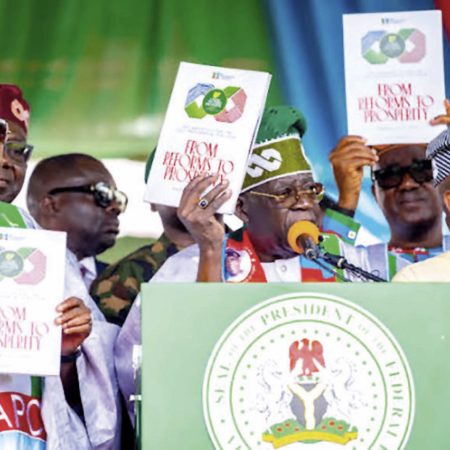
Every election produces a manifesto. Very few produce a measurable contract. President Bola Ahmed Tinubu and the All Progressives Congress (APC) appear to have done the latter with “From Reforms to Prosperity: Agenda 2027-2031” — the Renewed Hope Agenda 2.0.
This is not a document of vague promises. It is a document of baselines, targets, timelines and public accountability. It says: here is where we were, here is where we are, here is where we will be by 2031, and here is how you will measure us. That alone marks a profound shift in Nigerian politics — from politics of slogans to politics of evidence.
But no honest analysis can ignore the other side of the story. The first term was both praised and fiercely criticised. Supporters see courage and foundation-laying. Critics see pain, high costs and slow relief. Both views deserve to be heard, because it is in that tension that the 2027-2031 manifesto must be judged.
The first term: Courage or cost?
To understand the 2027-2031 manifesto, one must first understand the first term. Tinubu did not inherit a stable economy that needed gentle tweaking. He inherited an economy distorted by two monsters, in the words of the Minister of Information and National Orientation, Mohammed Idris Malagi: the petrol subsidy and the multiple foreign exchange regime.
Both were popular to keep and ruinous to sustain. The subsidy alone drained trillions of naira, benefited smugglers and a small cartel more than the poor, and starved states, schools, hospitals and roads of funds. The multiple exchange rate punished manufacturers, rewarded arbitrage and round-tripping, and made Nigeria unattractive to serious investors.
Tinubu removed the subsidy on day one and unified the exchange rate. He reformed the tax system to make it fairer and more predictable. Those decisions threw the country off balance in the short term, as Malagi admitted at the APC Presidential Campaign Council media parley in Lagos on November 23, 2026.
Here is where the criticism begins. For millions of Nigerians, the reforms were not felt as macroeconomic correction, but as immediate hardship. Fuel prices jumped from about N185 to over N600 within weeks, and later rose even higher. Transport fares doubled and tripled. Food prices soared. Rent, school fees and medicines became harder to afford. Labour unions, civil society groups and opposition politicians argued that the removal was too sudden, without adequate palliatives, CNG buses, or social safety nets already in place.
The naira unification also brought pain. The currency depreciated sharply, making imports, fuel, fertiliser, drugs and industrial inputs far more expensive. Small businesses that depended on imported raw materials struggled. Many Nigerians, especially in the informal sector, said they felt the reforms in their pockets long before they felt them in any national statistic.
Critics also point to insecurity. Despite the administration’s claims of progress, banditry, kidnapping and terrorism continued to claim lives in parts of the North-West, North-Central and North-East during the first term. Farmers in Benue, Zamfara, Plateau and Kaduna still fled their farms at different times. Parents still worried about school abductions. For these families, talk of “restored freedom” sounded distant from their daily reality.
There were also concerns about the distribution of the gains. While the Federation Account grew and states received more money, critics argue that many state governments did not translate that windfall into better roads, schools, hospitals or water. The cost of governance remained high, and many Nigerians questioned why they were asked to sacrifice while public officials still lived large.
These criticisms are real and must not be dismissed. They explain why many Nigerians see 2027 with mixed feelings: hopeful about the direction, but demanding proof that the next four years will be different.
The Government’s answer: Numbers and measurable targets
The manifesto is the government’s answer to those criticisms. It does not deny the pain. Tinubu himself has repeatedly thanked Nigerians for their patience and resilience. What it does is put numbers to the recovery and commit to measurable delivery.
Foreign reserves have grown to over $50 billion. The debt-to-GDP ratio remains within safe limits at 36.85 percent. Headline inflation has eased to 14.63 percent in September 2026, after spiking in the immediate aftermath of reforms. These are not abstract indicators. They are signs of a country that has stopped bleeding and started healing, even if healing has been slow for many households.
More importantly, the reforms have changed the structure of the federation. For the first time in decades, state governments have greater resources than ever before to invest in essential public services. As Bayo Onanuga, Special Adviser to the President on Information and Strategy, told journalists in Lagos, governors and local governments must now also be asked how they are using the huge allocations they are receiving. Accountability can no longer stop at Abuja.
That is the foundation on which Renewed Hope 2.0 is built. The first term rescued the economy from old instabilities. The second term, in Tinubu’s own words, “will turn stronger foundations into visible results in every state, local government, ward, and community.”
The manifesto is organised around four pillars and four foundations. The pillars are: a Secure and Resilient Nation; a Better Quality and More Affordable Life for Every Nigerian; Energy, Infrastructure and Economic Growth; and Effective and Accountable Governance. The foundations are macroeconomic stability, rule of law, institutional capability, and national cohesion.
What makes this manifesto different is not its poetry, but its precision. Let us examine it pillar by pillar, with the figures Tinubu himself has put on the table.
Read also: Tinubu’s mortgage revolution exposes the gap between housing finance and affordability
Secure and resilient nation: Security you can measure
Security is the most fundamental covenant between a nation and its people. Tinubu’s pledge is clear: to guarantee every citizen’s fundamental right to live, work, travel, learn, worship, and raise a family in greater safety, peace and liberty. In 2023, the administration committed to a systematic overhaul and institutional modernisation of the Armed Forces, the Nigeria Police Force, intelligence agencies, and paramilitary services. That meant expanding operational capacity against terrorism, rural banditry, armed kidnapping, and organised violent crime through modernised recruitment, advanced tactical training, reliable equipment acquisition, and structured welfare upgrades.
It also meant extending effective state authority across international frontiers, remote wilderness, and critical national infrastructure, leveraging biometrics, national identity databases, real-time intelligence fusion, community-led security partnerships, and strategic international security coalitions.
The government says the results are already tangible: security forces have restored freedom to thousands of citizens, and communities that were once no-go areas are returning to farming, trading and schooling. Critics counter that the gains have been uneven, and that kidnapping for ransom and rural banditry remain a daily fear in several states.
The 2027-2031 manifesto tries to settle that argument with measurement. It tells Nigerians exactly what to track:
Army strength: Four new divisions being established; 28,000 additional personnel approved to be recruited, trained, deployed and publicly reported. Police strength, 50,000 newly recruited officers to be trained and deployed towards a 1:400 police-to-citizen ratio. For the Civil Defence service, 30,150 approved personnel to be recruited, returning trained police officers to frontline duty.
Then greater attention to Border surveillance where 31 of 190 mapped areas still to be covered by e-surveillance and now there is a commitment to cover all mapped borders.
Further, in Mining Marshals, 420 of more than 530 identified sites protected with a commitment to protect all identified mining sites. While National identity enrolment has hit 137,260,026 enrolled as at June 2026.
These are published baselines. Nigerians can check them every year.
What this means in human terms is profound. A safer farming belt means a family in Zamfara or Benue can return to its land and harvest in peace. Fortifying school perimeters ensures parents in Borno, Kaduna and Niger can send their children to school under stronger protection. High-visibility, accountable policing enables traders in Aba, Kano, Lagos and urban centres nationwide to extend commercial hours within secure market corridors.
Sunday Dare, Special Adviser to the President on Media and Public Communications, captured this at the Lagos parley when he said the President’s agenda prioritises strengthening the military and police, improving intelligence gathering, and supporting the newly approved State Police framework to bring security closer to communities. Security is being decentralised, modernised and brought closer to the people.
Better quality and more affordable life: Food, health, education, homes
If security is the foundation, quality of life is the purpose. The manifesto’s second pillar promises a better quality and more affordable life for every Nigerian and it backs it with specific interventions.
Start with food, the most immediate test of government.
The manifesto notes that headline inflation has eased to 14.63 percent in September 2026. But it does not stop at inflation. It lists concrete measures that reach the market: The N200 billion Guaranteed Minimum Price scheme gives farmers a price floor, protecting them from ruinous price crashes.13,264.6 metric tonnes of rice from the strategic reserve have been distributed to 19 northern states and the FCT.
An additional 25,000 metric tonnes of national storage capacity help keep supplies steady.
By 2031, the promise is even bolder: domestic food production, storage and processing expanded, post-harvest losses halved, and goods moving more quickly and cheaply between states.
Critics will rightly ask: if inflation is falling, why is food still expensive in many markets? The government’s response is that prices are stabilising from a very high base, and that the new tax laws explicitly exempt basic foodstuffs, so reform does not add to what families pay for staple foods. Cash transfers, it says, cushion the most vulnerable households while prices settle. The second term will be judged not by inflation charts, but by the price of rice, yam, beans and garri in the market.
On education and health, the targets are equally precise: Out-of-school children halved. 20,000 additional teachers deployed.
Health insurance expanded from more than 23 million enrollees to 40 per cent of Nigerians.
Primary health centres functioning in at least 90 percent of facilities, up from 53 percent today.
These figures matter because they translate into a mother in rural Sokoto finding a functioning primary health centre, and a child in Makurdi finding a teacher in the classroom. The student loan scheme, already one of the most impactful social interventions of the first term, has given thousands of young Nigerians who would otherwise have dropped out the chance to stay in school. The second term will expand that promise, alongside increased medical school admissions and expansion of primary healthcare centres.
On housing, the manifesto promises a credible route to a decent home through 200,000 homes under the Tinubu Mass Social Housing Scheme, MREIF and FMBN mortgages and licensed private developers, tracked on a public dashboard. For working families, this is dignity, stability and wealth creation.
Energy, infrastructure and economic growth: Powering prosperity
For decades, Nigeria’s growth was held back by epileptic power and poor infrastructure. The Tinubu administration unlocked energy and natural resources for sustainable development, revived power sector reforms, encouraged private investment, and expanded infrastructure and transportation as enablers of growth.
The 2027-2031 manifesto raises the bar decisively: available power generation scaled towards 10,000MW for homes, businesses and communities.
For a tailor in Aba, a cold-room operator in Kano, or a tech startup in Yaba, reliable power is the difference between survival and growth. Critics note that despite years of promises by successive governments, power supply remains unreliable for many households. Tinubu’s team argues that this time the target is tied to generation, transmission and distribution reforms, not just rhetoric.
On the wider economy, the manifesto targets annual economic growth accelerated to 6 percent, youth unemployment halved, and equitable credit reaching half of all economically active Nigerians.
These are ambitious but grounded targets. They are backed by a commitment to accelerate diversification through industrialisation, digitisation, creative arts, manufacturing and innovation. Nigeria’s youth are not seen as a problem but as an asset. From Nollywood to Afrobeats, from fintech to fashion, the administration is positioning Nigeria’s creativity as an economic powerhouse.
Infrastructure is the physical expression of that ambition. Ongoing projects include the Lagos-Calabar Coastal Highway, the Sokoto-Badagry Highway, renewed rail, power and housing projects, and efforts to improve electricity supply across the country. Supporters see these as nation-building corridors. Critics have questioned their cost and priority. The government’s position is that they connect markets, reduce the cost of doing business, and open new opportunities for trade within Nigeria and across Africa under the AfCFTA.
Effective and accountable governance: A government that wants to be measured
Perhaps, the most important shift in Renewed Hope 2.0 is its emphasis on accountable governance. Every commitment is tied to clear targets and public progress updates. The manifesto promises digital case management extended from the superior courts to magistrate courts, public services tracked end-to-end, and local governments receiving their constitutional allocations with clear standards for results.
This is a government that wants to be measured, not just praised. It is a government that understands that prosperity cannot be built on weak institutions. The rule of law protects investors, citizens and businesses alike. Institutional capability ensures policies survive beyond personalities. National cohesion ensures no region, religion or tribe is left behind.
The APC campaign team, at the Lagos interactive session, assured journalists of open communication, timely access to information and regular engagements throughout the campaign period, and urged the media to interrogate the manifesto based on facts and verifiable achievements, rather than misinformation. That is the posture of a government confident in its record.
Why the second term matters — and why the balance favours Tinubu
Critics of reform often forget that rebuilding a nation is not a sprint but a marathon. The first term was about stopping the bleeding, removing distortions and laying foundations. The second term is about delivering visible results.
Yes, the reforms hurt. Yes, many Nigerians paid a heavy price in higher transport, food and living costs. Yes, insecurity did not disappear overnight, and many states did not use their increased allocations wisely enough. Those are legitimate grievances, and any honest assessment must acknowledge them.
But the alternative, keeping the subsidy and the distorted exchange rate, would have been far worse. It would have meant continued borrowing to pay for consumption, continued enrichment of cartels, continued collapse of investor confidence, and eventual economic collapse. Tinubu chose the hard right over the easy wrong. Other presidential candidates in 2023 also promised subsidy removal. Tinubu was the one who had the courage to do it.
Today, the evidence of stabilisation is no longer debatable: reserves over $50 billion, debt-to-GDP at 36.85 per cent, inflation down to 14.63 per cent, states with more resources, thousands freed from captivity, 137 million Nigerians enrolled for identity, and a clear, measurable plan for 2031.
Tinubu himself captures it best: “The first term rescued the economy from old instabilities and rebuilt the foundations. The second term will turn stronger foundations into visible results in every state, local government, ward, and community.”
If the first four years were about renewing hope, the next four are about fulfilling it. The pain was the price of foundation. Prosperity is the reward for patience. From reforms to prosperity is not just a slogan. It is a measurable journey from stabilisation to a Nigeria that is peaceful, prosperous and free — a Nigeria every citizen can see, feel and share.


Other Articles
ADC-PCC to Shettima: Focus on govt record, cost of living issues
Alaves end Real Madrid’s 10-game winning run as Bellingham sees red


No Comment! Be the first one.