


The Central Bank of Nigeria (CBN) has set a target to at least double the country’s private sector credit-to-GDP ratio by 2030, as part of efforts to deepen financial intermediation and ensure that the gains of banking sector reforms translate into increased financing for businesses and productive investments.
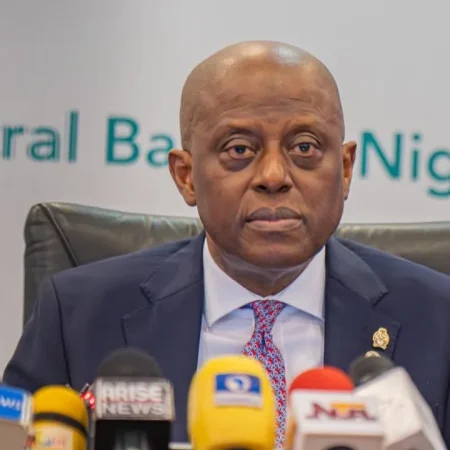
CBN Governor, Olayemi Cardoso, who disclosed this at the 61st Annual Bankers’ Dinner of the Chartered Institute of Bankers of Nigeria (CIBN) in Lagos, said the target would depend on sustained moderation in inflation and improvements in the broader lending environment.
He said the expansion of private sector credit must be pursued alongside sound lending practices and financial stability, stressing the need to build a financial system capable of supporting Nigeria’s growing economic aspirations.
“There is considerable scope to deepen financial intermediation in Nigeria. As inflation moderates and the broader lending environment improves, our ambition should be to at least double the private sector credit-to-GDP ratio by 2030, consistent with sound lending practices and financial stability,” Cardoso said.
The target comes as the banking industry concludes its recapitalisation exercise, which saw 33 banks meet the revised minimum capital requirements and raise approximately N4.65 trillion in fresh capital.
However, Cardoso said the next challenge was to ensure that the stronger capital base of banks translated into increased lending to the real sector, particularly productive enterprises that require affordable financing to expand their operations.
He acknowledged concerns over the high cost and limited availability of credit despite the stronger capital positions of banks, explaining that recapitalisation alone would not automatically improve access to financing.
“Stronger balance sheets are necessary, but the capacity of banks to lend affordably also depends on the environment in which they operate,” he said.
According to him, the monetary policy stance required to contain inflation, elevated credit risks across several sectors and weaknesses in credit assessment, collateral and enforcement infrastructure continue to influence the cost and availability of financing.
He said addressing these constraints would require sustained disinflation, stronger credit information and collateral systems, as well as closer collaboration with fiscal authorities to improve the environment for productive investment.
Cardoso also called for greater use of risk-sharing arrangements, loan syndication and collaborative financing structures, particularly for large-scale transactions that exceed the capacity or risk appetite of individual financial institutions.
He noted that banks should not be expected to meet every financing requirement individually or assume risks better suited to other investors.
The CBN governor further identified stronger domestic institutional investment, more developed capital markets and financial institutions capable of supporting businesses at different stages of growth as critical to achieving the 2030 ambition.
He said the financial system must evolve beyond traditional banking to accommodate fintech companies, payment service providers, mobile money operators and other institutions that have expanded access to financial services.
Citing the 2026 Access to Financial Services Survey, Cardoso said approximately 79 per cent of Nigerian adults now use formal or informal financial services, while 64 per cent access digital financial services.
However, he highlighted a significant gap between savings and borrowing through formal financial channels, noting that while 53 per cent of adults save formally, only 10 per cent borrow through formal channels.
“We have made considerable progress in bringing Nigerians into the financial system. The next frontier is to make financial access more useful in people’s daily lives,” he said.
He stressed that businesses with viable prospects should be able to access appropriate financing, while individuals should have financial products suited to their needs and circumstances.
Cardoso said the next phase of financial sector development would also require stronger capital markets and the capacity to attract and deploy long-term capital to support investment and economic expansion.
He maintained that the ultimate objective of the reforms was to ensure that a stronger financial system could mobilise capital for productive enterprise, support innovation and deliver better financial services to Nigerians.
The CBN governor said the responsibility before the banking industry was to ensure that stronger balance sheets translated into greater capacity to finance productive businesses, invest in the economy and serve customers more effectively.
He added that the Central Bank would continue to prioritise lasting price stability, a sound and resilient financial system and stronger financial markets to sustain the country’s economic progress.
We’ve got the edge. Get real-time reports, breaking scoops, and exclusive angles delivered straight to your phone. Don’t settle for stale news. Join LEADERSHIP NEWS on WhatsApp for 24/7 updates →

Other Articles




No Comment! Be the first one.