


Caleb University, Imota, Lagos State, has called for stronger collaboration between universities and industries to harness the opportunities offered by Artificial Intelligence (AI) for technological advancement and sustainable development in Nigeria.
The university said such collaboration had become imperative to ensure that innovations and research findings from academic institutions were transformed into commercially viable solutions capable of addressing societal and industrial challenges.
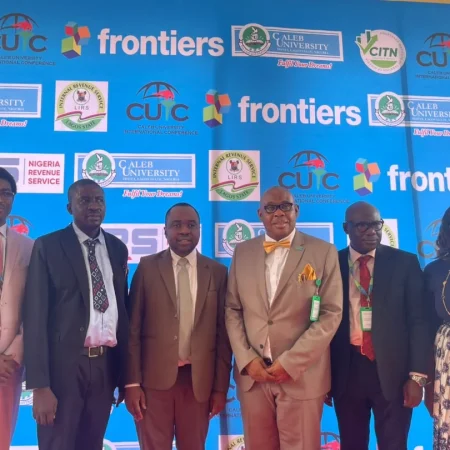
The Deputy Vice-Chancellor (Academics) of Caleb University and Chairman of this year’s International Conference, Professor Sunday Olumuyiwa Adewale, made the call while speaking on the significance of the conference themed, “Disruptive Innovation in the Artificial Intelligence Era: Advancing Academic-Industrial Synergies for Sustainable Growth.”
Adewale explained that the annual international conference was part of the university’s commitment to global best practices in higher education, providing a platform for scholars to present research findings, showcase their talents and demonstrate their research capabilities.
He said the choice of the theme was informed by the growing influence of artificial intelligence in virtually every aspect of human endeavour, stressing the need for researchers to explore ways of deploying the technology without compromising academic integrity and the fundamental objectives.
He added that the Federal Government had an agency saddled with the responsibility of promoting technology development and commercialisation of academic innovations and research outputs, noting that stronger engagement with such institutions would help accelerate technological development in the country.
On the quality of resource persons at the conference, Adewale disclosed that five keynote speakers from different parts of the world were selected based on their expertise and contributions to artificial intelligence.
They included the Vice-Chancellor of Miva Open University, Professor Tayo Arulogun; Professor Christian Harrison of the University of Manchester, United Kingdom; Professor Darren Lilley-Palmer and Professor Wunmi Ola, both of Bournemouth University, United Kingdom; and Professor Seun Kolade of Sheffield University, United Kingdom.
Adewale further emphasised the importance of exposing students to the ethical dimensions of AI, disclosing that the university deliberately incorporated them into the conference to deepen their understanding of the responsible application of the technology.
He said particular attention was given to students in their penultimate year and those undertaking research projects, as they needed to understand how to utilise AI as a supportive research tool without allowing it to undermine their critical thinking and independent academic contributions.
The DVC expressed confidence that the students who participated in the conference had gained valuable insights into the appropriate and ethical use of artificial intelligence in academic research.
He maintained that AI had come to stay, urging students and researchers to embrace its opportunities while upholding the principles of academic honesty, research integrity and intellectual responsibility.
The Vice-Chancellor of Caleb University, Prof. Olalekan Asikhia, who declared the conference open, warned students and researchers against allowing artificial intelligence to erode their intellectual capacity, originality and critical thinking, insisting that technology must remain a tool for learning rather than a substitute for human intelligence.
Asikhia cautioned that indiscriminate dependence on AI could gradually rob students of essential academic skills and leave them intellectually dependent on machine-generated content, stressing that the future of scholarship must be anchored on the ability to think, interrogate, analyse and produce original knowledge.
“Universities can no longer afford to remain isolated islands of theoretical knowledge. Through CUIC 2026, Caleb University is deliberately building a dynamic bridge where artificial intelligence and disruptive innovation directly serve industrial growth, youth employability, and sustainable national development,” Asikhia said.
The Vice-Chancellor, however, emphasised that the embrace of artificial intelligence must not come at the expense of intellectual development, urging students to retain their capacity for independent reasoning, writing and analysis, even as they explore emerging digital tools.
He also challenged lecturers to create opportunities for students to engage directly with learning and demonstrate their intellectual abilities, rather than allowing technology to dominate every aspect of academic work.
In a presentation on “The Ethical Use of Artificial Intelligence in Research,” Mr David Yusuf further interrogated the growing influence of AI on academic research, urging scholars to approach the technology with caution, discernment and a strong commitment to research integrity.
Yusuf cited the increasing adoption of artificial intelligence in research, noting that usage reportedly rose from 48 per cent in 2024 to 84 per cent in 2025, a development he said underscored the need for universities to integrate AI literacy into their curricula while preserving the central role of human intelligence.
He warned that AI-generated references and research citations could be unreliable, with some tools producing fictitious or inaccurate sources capable of undermining scholarship, compromising originality and exposing researchers to plagiarism and credibility challenges.
Professor Kolade examined digital transformation, institutional resilience and enterprise scaling in emerging economies, advocating policy incentives, innovation hubs and entrepreneurial research ecosystems capable of translating academic discoveries into viable businesses and industrial solutions.
WATCH TOP VIDEOS FROM NIGERIAN TRIBUNE TV

Other Articles

Abiodun plans N40m interest-free support for Ogun traders




No Comment! Be the first one.