


By Stella Odueme
The Federal Government has announced plans to establish at least one Sexual Assault Referral Centre in each of Nigeria’s 774 Local Government Areas as part of efforts to strengthen the fight against gender-based violence (GBV) and improve support for survivors even as AxtionAid Nigeria called for adequately funded survivor support services and accountability for perpetrators.
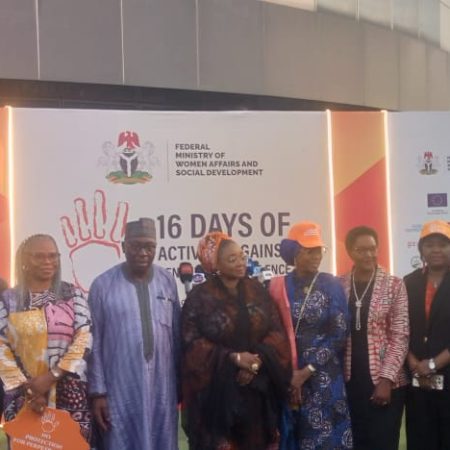
The Minister of Women Affairs and Social Development, Imaan Sulaiman-Ibrahim, disclosed this on Monday in Abuja at the 2026 Ministerial Press Briefing to flag off the International 16 Days of Activism Against Gender-Based Violence.
The minister said the existing 52 Sexual Assault Referral Centres across the country were inadequate for a population of over 240 million, hence the need to expand access to medical, psychosocial and referral services for survivors.
Speaking under the theme, “UNITE to End Violence Against Women and Girls: Ensure Justice, Protect Survivors, End Impunity,” Sulaiman-Ibrahim said the Federal Government was targeting 10.6 million organised women across the country’s 8,809 electoral wards through grassroots empowerment, economic inclusion and civic mobilisation.
She listed ongoing interventions to include the Renewed Hope Social Impact Interventions (RHSII-774), PowerHer 774, Happy Woman App, Digital Harmony and Women Rise, Innovate and Create, aimed at improving women’s economic independence, digital skills and access to opportunities.
The minister also announced that the National GBV Electronic Dashboard and Situation Room was now operational to strengthen data management, coordination and accountability. She added that the ministry had commenced the review of the National Gender Policy (2021–2026) and was developing a National Boy Child Policy.
She said the government was also implementing policies to address child marriage, menstrual health and unpaid care work, while strengthening existing legal frameworks, including the Child Rights Act and Violence Against Persons (Prohibition) Act.
The minister called on state governments, traditional and religious leaders, civil society organisations and the media to support efforts to end violence, stressing that the 16-day campaign must translate into 365 days of sustained action.
In her remarks, Niri Goyit, Women’s Rights Specialist at ActionAid Nigeria, who represented the organisation’s Country Director, Andrew Mamedu, called for consistent implementation of existing laws, adequately funded survivor support services and accountability for perpetrators.
Citing the 2024 Nigeria Demographic and Health Survey, Goyit said 21 per cent of women aged 15 to 49 had experienced physical or sexual violence, while 23 per cent of women who had ever been married or had an intimate partner had experienced physical, sexual or emotional violence from their current or most recent partner.
She stressed that survivors must be able to report abuse without fear of stigma, intimidation, retaliation or victim-blaming, urging federal and state governments, security agencies and justice institutions to close implementation gaps and ensure accessible justice for all survivors.
Goyit reaffirmed ActionAid Nigeria’s commitment to working with the government and other stakeholders towards a country where violence against women and girls is neither normalised nor tolerated.
Also speaking, the United Nations Population Fund (UNFPA) Resident Representative in Nigeria, Ms. Muriel Mafico, called for stronger enforcement of laws, increased funding for survivor support services and action against harmful social norms.
Mafico said UNFPA, in partnership with the Federal Ministry of Women Affairs and other government agencies, had established five One-Stop Centres, providing integrated services to more than 2,900 survivors and their families.
She added that the organisation had strengthened seven Sexual Assault Referral Centres, trained over 300 health workers in the clinical management of rape and GBV cases, and supported more than 12,000 girls and boys with psychosocial services, life skills and mentorship.
She further disclosed that 28 lecturers from Kaduna State University had recently completed a Training of Trainers course on gender-based violence in emergencies.
Mafico identified three priorities for tackling GBV: strengthening implementation and accountability, investing in essential survivor-centred services, and addressing the root causes of violence through community engagement and the involvement of men and boys.
She urged stakeholders to adopt UNFPA’s campaign message, “Name it. Believe it. End it,” saying the success of the campaign should be measured by the number of women and girls who could live free from violence and access justice.
The International 16 Days of Activism Against Gender-Based Violence runs from November 25 to December 10 annually.

Other Articles

Iranian currency falls sharply after fresh US sanctions




No Comment! Be the first one.