


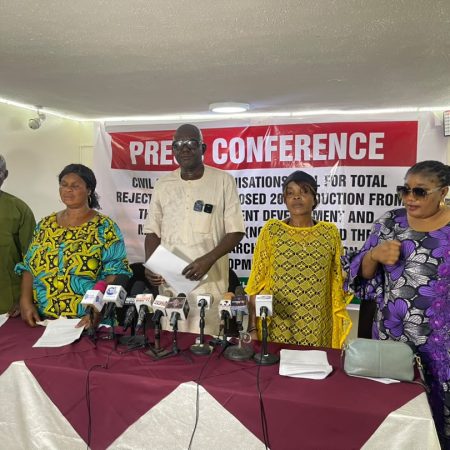
The Coalition of Civil Society Organisations in Nigeria (COCSON) has called on the National Assembly to remove a proposed 20 per cent deduction from the revenue of the Nigerian Content Development and Monitoring Board (NCDMB) to finance the proposed National Research and Innovation Development Fund.
The coalition warned that the proposed funding arrangement could undermine Nigeria’s local content development efforts, weaken indigenous capacity in the oil and gas industry and create a dangerous precedent for diverting funds belonging to established government agencies.
Addressing a press conference in Abuja on Thursday, COCSON spokesperson, Tabuko Kennedy, said the coalition was not opposed to the establishment of a national research and innovation fund but strongly rejected the proposed funding model.
Kennedy described the proposed deduction as unacceptable, arguing that funds generated through the NCDMB were specifically intended to develop local capacity and promote indigenous participation in the oil and gas sector.
“Let us be unequivocal: This is totally unacceptable. It is totally wrong. It is highly unpatriotic. And it must be jettisoned immediately,” he declared.
The coalition maintained that diverting 20 per cent of the NCDMB’s revenue would deprive the board of resources required to support indigenous companies, train Nigerian professionals and strengthen local industrial capacity.
According to COCSON, every naira allocated to the board represents an investment in developing local expertise, creating opportunities for Nigerian businesses and retaining more wealth within the country’s economy.
“If we take 20% away from the Local Content Board to fund a new research body, we will starve the oil and gas sector of the funds it needs to mature. You cannot claim to promote national development while crippling the engine that drives local industrial capacity,” the spokesperson said.
COCSON also questioned the justification for using NCDMB revenue to finance an institution whose mandate, according to the coalition, is different from the purpose for which the funds were originally collected.
It argued that contributions to the board come from companies operating in the oil and gas industry and are specifically earmarked for developing Nigerian content.
Describing the funds as stakeholders’ resources rather than surplus government revenue, the coalition said diverting part of the money without adequate consultation would undermine the understanding between industry operators and the government.
“NCDMB funds accrue from deductions from the very companies operating in the oil and gas sector, specifically earmarked to develop local capacity. It is a social contract between industry stakeholders and the Nigerian people,” Kennedy stated.
“A new body cannot simply jack away 20% of this money. To unilaterally deduct 20% from the stakeholders’ pool without their consent, and without alignment to the mandate for which the money was collected, is a breach of trust.”
The coalition further warned that approving the proposal could encourage other agencies to seek access to funds generated by existing institutions through legislative provisions.
It cited the possibility of similar deductions from the Tertiary Education Trust Fund (TETFund), Universal Service Provision Fund (USPF) and Police Trust Fund, warning that such a development could undermine the financial independence and long-term planning of government agencies.
“What stops the next Bill from taking 30% of the Tertiary Education Trust Fund (TETFund)? What stops another from raiding the Universal Service Provision Fund (USPF) or the Police Trust Fund?” it queried.
COCSON said allowing new institutions to depend on revenue belonging to existing agencies could discourage effective revenue generation and create unnecessary competition among government institutions.
The group also raised legal concerns over the proposed deduction, insisting that the Nigerian Oil and Gas Industry Content Development Act established a framework for applying NCDMB funds to local content development.
According to the coalition, diverting the revenue to finance a separate research and innovation institution would undermine the original statutory purpose of the funds.
It argued that the proposed arrangement would require careful legal consideration, particularly regarding the existing legislation governing the NCDMB and the purposes for which its revenue is collected.
Reaffirming its position, COCSON stressed that its opposition was directed at the proposed funding mechanism rather than investment in research, innovation and technological development.
“COCSON is not against research. We are not against innovation. But we are violently opposed to a flawed, destructive, and unpatriotic funding mechanism,” Kennedy said.
The coalition consequently appealed to the leadership of the National Assembly, relevant legislative committees and the Federal Executive Council to discontinue the proposed 20 per cent deduction.
It also called on President Bola Tinubu not to assent to the bill if it retains the controversial funding provision.
“We call on President Bola Ahmed Tinubu NOT to embarrass the government by signing such a bill,” the spokesperson added.
COCSON disclosed that it had begun mobilising organised labour, pressure groups, religious organisations and other civil society groups to oppose the proposed legislation.
The coalition said the groups had indicated their readiness to join efforts to resist the funding arrangement, adding that it would not allow what it described as the diversion of resources meant for local content development.
It, however, urged lawmakers to explore alternative and sustainable funding options if the proposed National Research and Innovation Development Fund is to be established.
“If the Bill must proceed, a different, non-destructive funding model must be explored and clearly defined,” Kennedy said.
The coalition called on industry stakeholders and Nigerians to engage with the legislative process, insisting that funding for research and innovation should not come at the expense of existing institutions with clearly defined statutory responsibilities.

Other Articles

Moniepoint mobilises banks, customers against phishing scams
FG targets 20,000 women, children in Imo health insurance



No Comment! Be the first one.