


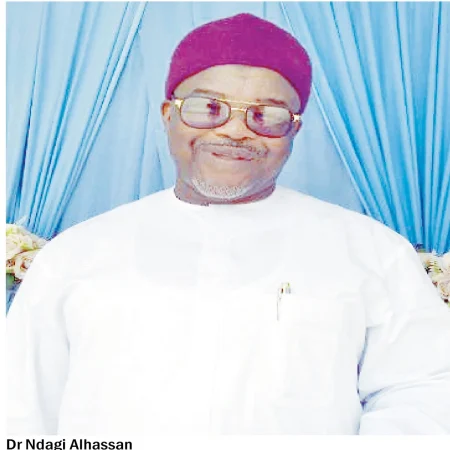
In this interview with Sade Oguntola, Registrar of the Nursing and Midwifery Council of Nigeria (NMCN), Dr Ndagi Alhassan, discusses the planned central nursing internship programme, the Council’s crackdown on illegal nursing institutions and quackery, and the rationale behind the two-year requirement for international verification. He also highlights ongoing reforms to improve nursing education, strengthen professional regulation and address challenges in the healthcare workforce.
The decentralisation of nursing internship was previously announced but is yet to commence. What is its current status, and when is implementation expected to begin?
A: Government approval does not necessarily translate into immediate implementation. However, following our engagements with the Budget Office of the Federation, we are optimistic that full implementation will commence in January 2027.
We have received reassurances that the Central Nurse Internship programme has been captured in the national budget, unlike last year when the budgetary disbursement encountered operational challenges. The Council is hopeful that the administrative process will be finalised in time to enable the Council to commence the central mobilisation and placement of nursing interns in federal health institutions and facilities nationwide by January 2027. I hope and pray that by January 2027, Nigerians will be happy to witness the deployment of the first batch of nursing interns centrally.
What is the Council doing to address quackery, illegal nursing training institutions and professional misconduct?
As a statutory regulatory body, the Council is charged with enforcing national standards, establishing operational guidelines, and ensuring strict compliance with regulatory procedures.
These mandates are essential to protecting public health, preserving professional standards, and eliminating unlawful practices across the federation. The Council now has a Governing Board and a Disciplinary Tribunal responsible for handling professional misconduct among registered nurses.
The Council’s Act recognises State Nursing and Midwifery Committees, headed by the Directors of Nursing Services in each state. These committees investigate reported cases and refer serious matters to the Council where necessary.
The National Association of Nigerian Nurses and Midwives also has a responsibility to monitor illegal activities within the profession and involve law enforcement agencies where necessary.
Additionally, the Council has a representative of the Nigerian Armed Forces on its board to assist with cases involving fraud and malpractice.
The review of the Council’s Act in 2022 also captured quackery and illegal training institutions, with revised sanctions currently under consideration. Further activities include licence drives and taskforce intervention. The Council Zonal offices conduct joint inspections unannounced of suspected facilities with the State Nursing and Midwifery Committee, Director of Nursing, Ministry of Health and the Police or Civil defence. They form a task force to conduct inspection and licence drives, shutting down or sealing illegal schools.
It includes identifying quacks, unlicensed practitioners and impersonators who are handed over to law enforcement agencies for legal prosecution; maintaining accreditation; Training Standards of institutions
Other activities include a moratorium on the establishment of new nursing training institutions to focus on consolidating quality in existing ones; phasing out online/ODL models for basic nursing due to lack of hands-on experience and capacity for clinical training; and conducting mandatory resource verification for quality evaluations before increasing student admission quotas or additional programmes.
In addition, digital automation of all services for fraud prevention while moving licensing, indexing, and exams fully online to eliminate document forgery and related frauds.
Also, the council operates an instant verification digital portal for employers and global bodies to confirm active registration and licensure status. So, it closed all manual channels for verification to stop counterfeit credentials.
It also enforces professional discipline through the Disciplinary Tribunal by investigating malpractice, petitions, and ethical violations through the Nurses.
The council’s disciplinary tribunal committee applies sanctions and penalties ranging from formal reprimands to permanent strike-off from the register for the offender for gross misconduct.
We ensure mandatory continuing professional development education (MCPD) for 3-year license renewals to maintain clinical competence.
So, what constitutes quackery in nursing?
Quackery occurs when someone undertakes professional responsibilities without the appropriate training. For instance, a general nurse practicing as an ophthalmic nurse without specialist training is engaging in quackery. It also includes individuals who have never attended an accredited nursing institution but present themselves as nurses.
The categories include impersonation, practice without active registration/licence, overstepping authorised scope; auxiliary training schemes by private clinics, maternity homes, or unauthorised centres and unaccredited/unapproved training institutions.
Others are credential fraud, such as forging, purchasing, or altering professional certificates and licensing cards, as well as deceptive titles like ‘sister’ and ‘matron’ in clinical settings without meeting legal qualification standards.
Unregulated clinical outfits such as mobile clinics, maternity homes, or home-care services led by unqualified individuals using fake or expired documentation are also quackery.
How many illegal training facilities have been closed down?
I have 143 cases with the Economic and Financial Crimes Commission (EFCC) and the Independent Corrupt Practices and Other Related Offences Commission (ICPC). The cases involve illegal establishment of institutions and other forms of misconduct across the country.
Does the Council have guidelines regulating nurses’ conduct on social media, particularly those providing potentially dangerous medical advice?
Yes. The State Nursing and Midwifery Committees monitor such activities. Where a registered nurse is involved, the matter can be referred to the Nurses’s Disciplinary Tribunal. Our legal unit also facilitates referrals to law enforcement agencies. Some individuals, after being identified and informed that their conduct was inappropriate, have expressed remorse, appealed and withdrawn the activities in question.
Despite the increasing number of nursing graduates, hospitals continue to experience staff shortages. What accounts for this situation?
The Council’s responsibility is primarily policy development, service-delivery oversight and regulation of the profession. Employment and retention largely fall within the responsibilities of federal and state governments.
Nursing production is ongoing, and the number of graduates has increased. The Federal Government has directed teaching hospitals to employ nurses, but the reasons the directive has not been fully implemented are beyond what I can explain.
Similarly, many state governments do not recruit nurses annually. Some general hospitals have only one registered nurse, which is unacceptable and affects healthcare delivery. The problem is not necessarily a shortage of trained nurses. Many qualified nurses remain unemployed, and the reasons for their non-employment require government attention.
With the Federal Government encouraging increased nursing enrolment, how can inadequate training facilities and equipment be addressed to ensure quality education?
The Council has identified inadequate equipment in some nursing institutions as a major challenge. We are establishing a central electronic library accessible to all training institutions.
We are also developing a central e-skills laboratory, with the National Procedure Guide incorporating links to virtual demonstrations of nursing procedures.
For hands-on training, we are adopting a collaborative approach to help institutions equip their laboratories. Additionally, the Federal Government plans to establish large simulation centres in six states, strategically located between teaching hospitals and universities. These centres will serve both students and practising healthcare professionals seeking practical training.
The Council’s verification guidelines and two-year requirement have generated concerns among nurses seeking international employment. What informed the policy, and what does it entail?
The two-year requirement is a Federal Government measure intended to maintain adequate nursing manpower in Nigeria while improving the clinical competence of newly graduated nurses. Previously, many nurses applied for verification immediately after graduation to travel abroad.
However, concerns emerged about the practical competence of some newly graduated nurses working internationally.
Nigeria is a major supplier of nursing personnel globally, alongside India and the Philippines. Nigerian nurses are particularly sought after because their training prepares them to function across primary, secondary and tertiary healthcare settings. They are often described as polyvalent nurses because their education covers nursing and public health.
The Council therefore introduced a requirement for nurses to spend one year undertaking an internship and another year completing the National Youth Service Corps (NYSC). This provides opportunities for mentorship and practical experience while ensuring that healthcare facilities retain needed personnel.
But some nurses alleged that the portal closure and verification requirements are designed to frustrate their plans to migrate. What is the Council’s response?
That is not the intention. Before verifying a nurse for international practice, the Council requires a letter of good standing from the nurse’s immediate supervisor confirming satisfactory professional performance and competence.
Where does the Council stand on the transition from diploma qualifications to the Bachelor of Nursing Science (BNSc) as the entry qualification? What happens to existing diploma holders?
Previously, nurses received professional certificates, which were difficult to accommodate within the public service career structure. The system subsequently moved to academic qualifications, including diplomas.
Diploma holders can still practise, but their career progression within the public service is limited. Degree holders, however, can progress to the level of Director of Nursing Services.
The Council has provided opportunities for diploma holders to return to school and obtain degree qualifications to improve their career prospects.
What is the Council’s position on the HND-to-degree dichotomy?
This is a national issue. The Federal Government is working to address the disparity, although there has been some resistance. Programmes are being developed to provide opportunities for affected graduates to attain comparable academic and professional standing. We are hopeful that the dichotomy will soon be resolved.
How does the Council ensure that foreign-trained nurses returning to Nigeria meet the required professional standards?
Their certificates and the authenticity of their training institutions are verified. They must then undergo a six-month adaptation programme before sitting for the Council’s professional examination. Successful candidates can subsequently be registered to practise in Nigeria.
When will the Council fully digitalise its licensing and licence-renewal processes?
The processes are already digitalised. Although complaints about delays were previously received, those delays are no longer an issue.
How is the Council collaborating with agencies such as NAFDAC and the Pharmacy Council of Nigeria on task shifting and task sharing?
The Federal Government has established a committee to examine task-sharing and task-shifting activities. Its position on the matter will be published soon.
What major reforms should Nigerian nurses expect from the Council over the next year?
We have educational reforms planned to promote nursing education, improve service delivery and enhance patient comfort. Our goal is to ensure that nurses provide the highest standard of care.
This aligns with the Council’s vision of promoting excellence in nursing education in line with global best practices and becoming a leading nursing regulatory body with the best nursing and midwifery professionals.
What should patients do when they have complaints about nurses’s conduct or professional performance?
They are free to report such complaints to the Nursing and Midwifery Council of Nigeria through the State Nursing and Midwifery Committee.
WATCH TOP VIDEOS FROM NIGERIAN TRIBUNE TV

Other Articles

Adamawa frees 65 inmates, grants bail to 51 – Daily Trust
Adamawa Launches 2027–2031 Road Map For Harnessing Demographic Dividend




No Comment! Be the first one.